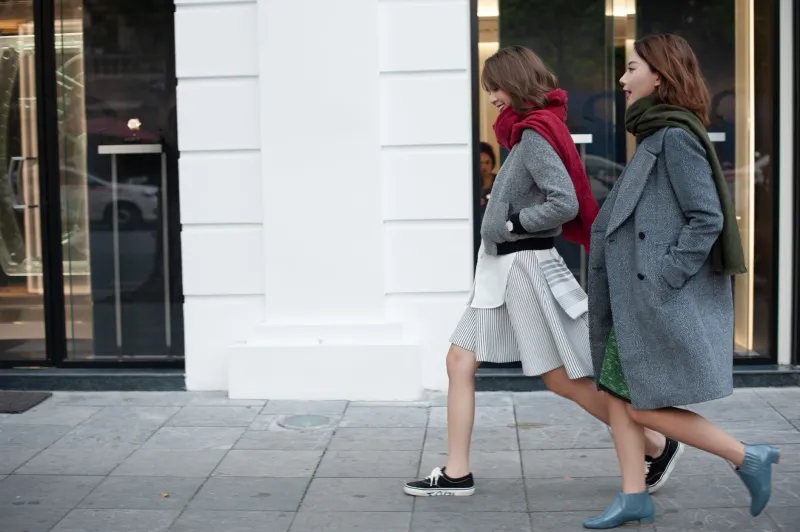
One Colour, Worn Properly: The Accent Rule for a Grey British Wardrobe

British wardrobes have a default setting. Navy, grey, camel, black. Maybe a stripe. It is not boring, exactly. It is practical, hard-working and very good at hiding commuter coffee spills. But by November, after months of overcast skies, the palette can start to feel like the weather: safe, sensible and slightly flat.
The answer is not a rainbow. It is one colour, used deliberately. A single accent per outfit, repeated once or twice, against a neutral base. The rest of the wardrobe stays British and wearable. The colour does the talking.
Why we default to navy and grey
This is not a criticism. Navy and grey are excellent. They suit British light, they work with almost everything, and they do not demand a personality change before breakfast. Camel is the same: a good camel coat is a shortcut to looking pulled together. Black is the national uniform for a reason.
But default dressing can become invisible dressing. When every outfit is a variation on the same four colours, the eye stops noticing. The clothes are fine. The person disappears. A controlled accent gives the eye somewhere to land.
The one-colour rule
Pick one accent colour per outfit. Not one per wardrobe, one per outfit. Then keep the rest neutral. A grey suit, a burgundy knit, black shoes. Navy trousers, a cobalt scarf, a camel coat. Black jeans, an ochre beanie, a grey jumper. The accent can be a jumper, a scarf, a bag, socks, a belt or a pair of gloves. It should not be all of them at once.
A useful guide: around 15 to 20 per cent of the outfit. One visible piece, plus maybe a small echo. If the scarf is green, the socks can be green. The bag can stay black. The coat can stay navy. That is enough.
Shades that work in British light
Overcast light is soft and slightly cool. It flatters muted, saturated colours more than neon or icy pastels. Think bottle green, burgundy, raspberry, cobalt, teal, mustard and rust. These shades have enough depth to hold their own against grey skies without looking like a high-vis jacket.
Bottle green is the easiest entry point. It works with navy, camel, black and denim. Burgundy is the winter alternative to red that does not shout. Cobalt is for anyone who wants a cleaner, sharper hit. Mustard and rust are warmer; they look good with brown boots and camel coats. Raspberry is the one to try if you want something softer than true pink but still visible.
Avoid the temptation to buy the exact shade you saw on a catwalk. Buy the version that works with your coat. If your coat is camel, bottle green and burgundy are almost foolproof. If your coat is black, cobalt and rust will lift it. If your coat is navy, mustard and raspberry add warmth.
High-street combinations that work
For work. A grey suit with a burgundy fine-knit jumper instead of a white shirt. Black loafers or boots. The suit stays neutral; the knit is the accent. If you do not wear suits, try navy trousers, a grey blazer and a cobalt scarf. The scarf does the same job.
For the weekend. Black jeans, a grey marl jumper and an ochre beanie. Or dark denim, a camel coat and a bottle-green crossbody bag. The bag is the only colour. That is the whole trick.
For a cold-weather walk. Navy quilted jacket, black leggings or trousers, rust socks and a matching rust beanie. It looks intentional without looking like you are auditioning for a ski advert.
For evening. A black dress or black trousers with a teal bag and teal earrings. Keep the shoes black. One colour, two small touches. It is quiet, but it is not invisible.
Work-to-weekend: swap the accent, not the base
A useful way to make this feel less like a capsule wardrobe rule and more like real life: keep the base the same and change the accent. Your work base might be navy trousers, a grey knit and black boots. For the weekend, swap the grey knit for a burgundy one. Same trousers, same boots, different mood.
Or keep the outfit and change the accessory. A camel coat, black trousers and a cream jumper works for the office with black gloves. On Saturday, add a bottle-green scarf and a canvas tote. The clothes have not changed. The colour has.
Do not match everything
The risk with an accent colour is looking too considered, like you bought the whole display. Leave something neutral. A green scarf with a green bag, green socks and green earrings is a costume. A green scarf with a navy coat, black trousers and black boots is a choice. The neutral pieces give the colour room to breathe.
This is not about becoming a different dresser. It is about giving the clothes you already like a bit of voltage. One colour, worn with confidence, is often enough. The British wardrobe does not need a full repaint. It needs a single, well-chosen stroke.