The Quiet Fix at Your Neck: Why a Square Scarf Outperforms Another Coat
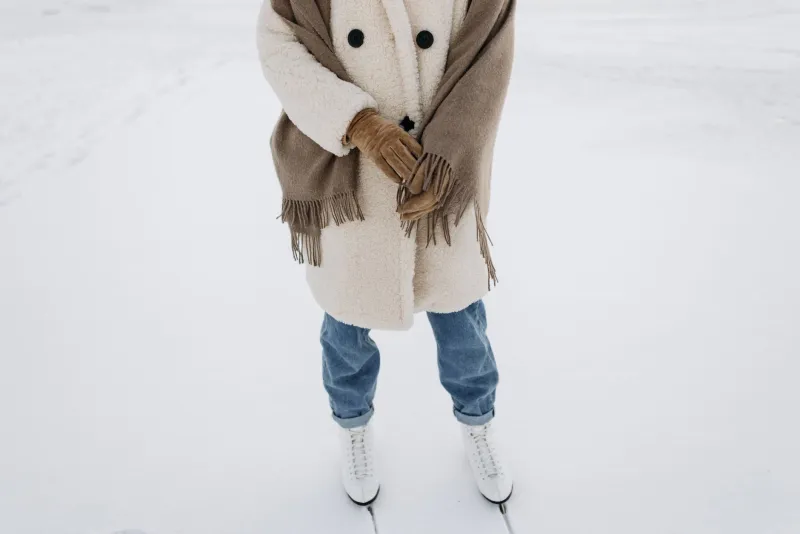
There is a moment in every British winter when the coat stops being the interesting part. You have worn it to the office, to the pub, to the supermarket, to the school gate, and it has done its job without complaint. What changes the outfit is not another jacket. It is the thing at your neck.
A square scarf is the quiet fix. It adds warmth exactly where you feel the cold first, it comes off on the Tube without dismantling your whole look, and it can make a familiar coat read differently on a Tuesday than it did on Saturday. The arithmetic is simple: one good square, several coats, fewer regrets.
Why the scarf does more than the coat
A winter coat is structure. It is the silhouette people see from across the street. A scarf is the detail they notice when they sit opposite you on the train. It is also the layer that does the most practical work for its size. A close wrap at the neck traps warmth without adding bulk at the shoulders, which is why a £30 square can sometimes feel more useful than a heavier coat you only wear twice a week.
The other advantage is cost per wear. If you wear the same black coat five days out of seven, a scarf is the cheapest way to stop it looking like a uniform. Change the colour, change the fold, change the texture, and the coat reads as a background rather than the whole story.
The three square sizes that earn their space
Not every scarf needs to be enormous. The size dictates how it folds, how warm it is, and whether it looks deliberate or slightly drowned.
70cm square. This is the neckerchief size. It works best with a blazer, a crew-neck knit or a coat with a clean collar. Fold it into a narrow band, wrap once, and tuck the ends in. It is not a deep-cold scarf, but it is excellent for the in-between days that Britain specialises in — the ones that start at eight degrees and end at four.
90cm square. This is the workhorse. In wool or a wool blend, it is big enough to fold into a triangle and wear bandana-style, long enough to wrap once and tuck, and neat enough to sit under a coat without bunching. If you only own one square, make it this one.
120cm and above. The blanket square. This is for the properly cold mornings, the ones where the wind comes sideways off the river or down a high street with no shelter. Look for fine wool rather than thick acrylic; you want warmth without a neck brace. It should wrap twice and still let you turn your head.
Folds that survive a bus stop
The test of a scarf is not how it looks in the hallway mirror. It is whether it is still doing its job after ten minutes at a windy bus stop.
Start with the bias fold. Fold the square corner to corner into a triangle, then keep folding from the long edge towards the point until you have a long band. Wrap it once around your neck, cross the ends at the front, and tuck them under your coat. This holds because the weight sits inside the coat, not flapping about outside it.
For the 90cm square, try the triangle tuck. Fold in half diagonally, place the triangle at the front, take the two ends around the back, bring them forward and knot them once over the triangle. It looks tidy with a crew neck and adds a useful extra layer without bulk.
The once-round is the simplest. Fold the square in half to make a triangle, then hold the two top corners and wrap the whole thing around your neck, feeding the ends through the loop. Pull it snug, but not tight enough to interfere with your coat collar. If the ends hang loose below your waist, tuck them into your belt or inside the coat. Loose ends are decorative; tucked ends are warm.
Colour that flatters the coats you already own
Start with the coat, not the scarf. If your winter coat is navy, a scarf in cream, oatmeal, burgundy or a navy-and-cream check will all work. If it is camel, try chocolate, rust, forest green or a soft grey. With a grey coat, almost anything goes, but a deep berry or a muted blue looks particularly good against British light.
A useful rule: choose a scarf that is either one step lighter or one step darker than your coat, rather than a colour that fights it. A bright scarf can be brilliant, but it needs to look intentional. Hold it near your face in daylight before you buy. If it makes your skin look tired, it is the wrong shade, however good it looks on the hanger.
Pattern is your friend if you own several coats in different colours. A check or stripe that contains one of your coat colours will pull the whole wardrobe together without demanding a new coat.
The chunky test
Before you buy, scrunch the scarf in your hand. Does it hold its shape, or does it collapse into a thin rag? Hold it up to the light. If you can see straight through it, it will not stop a cold wind. Rub the fabric between your fingers. If it pills immediately or feels squeaky, walk away.
A scarf is chunky enough to matter if it can be folded into four layers at the neck without feeling like a neck cushion. It should feel substantial but not stiff. If it slips off your shoulders the moment you move, it is decorative. Decorative is fine, but it is not the scarf that will rescue your winter wardrobe.
The £15–£60 high-street shortlist
Prices move around, so treat these as a guide rather than gospel. Uniqlo’s lambswool square scarves are usually around £20 and fold well. M&S does reliable pure wool squares for about £25. H&M often has wool-blend squares for under £20, though check the label for acrylic content. John Lewis cashmere-blend scarves sit nearer £35–£45 and feel softer than the price suggests. Arket and COS both do excellent oversized wool squares in the £45–£60 range if you want the blanket size without the blanket price.
The best scarf is not the most expensive one. It is the one you reach for without thinking, the one that makes a grey Monday coat feel like a decision rather than a default. Buy one square in a size that suits your coat, a colour that suits your face, and a fabric that blocks the wind. That is the maths worth doing.