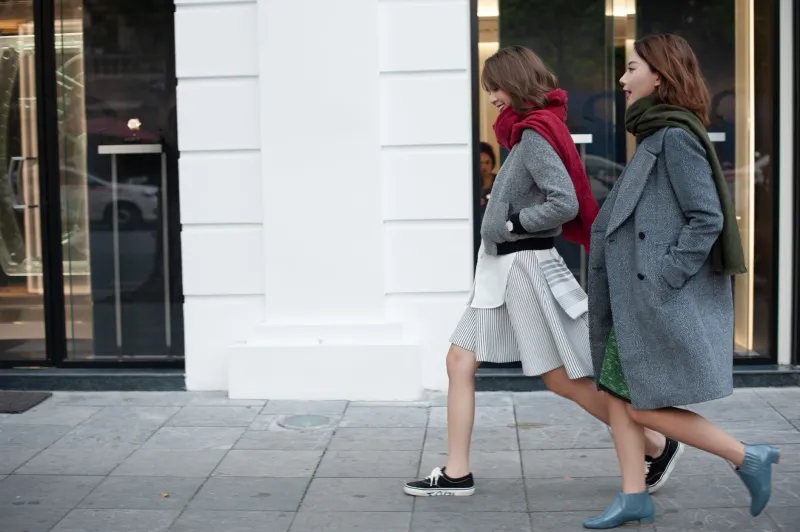
The Sleeve-and-Hem Trick That Makes High-Street Buys Look Bespoke

There is a particular kind of high-street frustration that has nothing to do with price. You buy a decent jumper, a sensible pair of trousers, a coat that looked promising on the hanger, and somehow the whole thing reads as ordinary. Not bad. Just a bit undefined. The fix is often not a new purchase but a small shift in proportion — specifically, letting more of your outfit stop at the three-quarter point rather than the full-length one.
The idea is simple enough. A sleeve that ends mid-forearm, a skirt or dress hem that hits just below the knee or at the narrowest part of the calf, a trouser that finishes at the ankle rather than gathering on the shoe. These endings create shape. They show a bit of wrist, a bit of ankle, a bit of leg, and that visual pause is what makes an outfit look considered rather than merely covered.
Why a little less length reads as more expensive
High-street clothes are cut for a broad range of bodies and budgets, which means hems and sleeves are often generous. That generosity is useful, but it can blur the line of a garment. When a sleeve swallows the hand or a trouser pools over a trainer, the eye has no clear place to rest. Shorten the ending and the same piece suddenly has a silhouette.
This is not about tightness. It is about finish. The three-quarter rule works because it creates a clean edge. A cropped knit over a longer shirt, an ankle-grazing jean with a loafer, a coat sleeve pushed or altered to show a cuff — all of these make the wearer look like they made a decision. And in British weather, when we are often layering anyway, that decision-making is half the style battle.
Start with sleeves
Sleeves are the easiest place to test the idea. A chunky jumper that ends at the wrist can feel heavy; the same jumper with the sleeve pushed to mid-forearm feels lighter and more intentional. You do not need to alter anything. Just push, fold or cuff. With knits, a neat turn-back works better than a messy scrunch. With shirts, showing two or three centimetres of cuff beyond a jumper or blazer is a classic British styling move for a reason.
On the high street, look at Uniqlo merino crews, M&S Autograph knits and Cos jumpers with slightly shorter bodies. These pieces often benefit from a sleeve that stops just above the wrist bone. If you are between sizes, do not automatically size up for a looser look; check the sleeve length first. A relaxed body with a sleeve that ends in the right place looks far sharper than an oversized everything.
For coats, the rule needs a gentler hand. A wool coat from Whistles or Hobbs with a sleeve that ends at the wrist is fine. The trick is to let the knit or shirt underneath extend slightly beyond it. That small contrast of lengths makes the coat look tailored rather than borrowed.
Hemlines: the knee is not the enemy
Skirt and dress hems are where people get nervous. The temptation is to go long and safe, especially in winter. But a midi that ends at the widest part of the calf can make the whole outfit look heavier than it is. A hem that finishes just below the knee, or at the narrowest point above the ankle, does more for the line of the body.
This does not mean mini. It means paying attention to where the fabric stops. A knitted dress from Arket or John Lewis that ends mid-calf can look excellent with a boot, but if it hits the widest part of your calf, try a different length or add a boot with a closer shaft. A satin skirt from Next or Mango will look more modern with a hem that grazes the top of a shoe rather than sweeping the floor.
If you are wearing a longer coat, the hem of the dress or skirt underneath becomes a secondary line. Let it show by a few centimetres. That layering of lengths is a very easy way to make a simple outfit look more deliberate.
Trousers and the ankle gap
Trousers are the most transformative place to apply the rule. A straight-leg jean that breaks over a trainer can look sloppy; the same jean cropped to the ankle looks cleaner and makes the shoe feel part of the outfit. You do not need a tailor for every pair. A simple turn-up can work on denim from Levi’s, H&M or & Other Stories, provided the turn is neat and not too deep.
With tailored trousers, aim for a hem that skims the top of the shoe rather than sitting on the floor. M&S and Next do good affordable cigarette trousers that often need a small cuff or alteration. If you are wearing boots, check that the trouser does not bunch at the knee when you sit down. The three-quarter idea is about a clean ending, not a constricted one.
A good test: stand in front of a full-length mirror and look at where the fabric stops. If it stops at a narrow point, you are probably on to something. If it stops at a wide point and you feel swamped, change the shoe or the hem.
Before and after: a Saturday test
Try this on a normal weekend. Put on a jumper, straight jeans and boots. Look at the sleeve and the hem. Now push the sleeve to mid-forearm and turn the jean once at the ankle. The difference is rarely dramatic, but it is visible. The outfit has more shape and less fabric noise.
Do the same with a coat. Wear it over a knit that ends at the wrist, then try a shirt cuff or a slightly longer sleeve underneath. The coat will look more expensive because the layers are doing something rather than just sitting there.
When to break the rule
Like any styling rule, this one has exceptions. Longline coats, wide-leg trousers, maxi skirts and deliberately oversized knitwear can all look brilliant when the volume is the point. The key is to balance the ending. If you go long and loose on top, keep the shoe or the hem sharp. If you go wide on the bottom, show a wrist or a neckline. The rule is not about shortness for its own sake. It is about clarity.
Also ignore it when the weather demands otherwise. A freezing January morning is not the moment to force an ankle gap if you will be miserable. Wear the longer trouser, the proper boot, the coat that covers your hands. Style that makes you cold is not style. It is just a photograph waiting to end.
The three-quarter rule is really a finishing rule. It asks you to notice where things stop. Once you do, high-street clothes stop looking like they are waiting for a tailor and start looking like they were chosen. That is the whole trick.